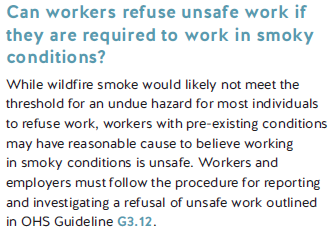
According to WorkSafe BC, Workers with pre-existing conditions may have reasonable cause to believe that working in smoky conditions is unsafe. Workers need to follow the Refusal of Unsafe Work reporting procedure and Employers need to Investigate OHS Guideline G3.12 https://www.worksafebc.com/en/law-policy/occupational-health-safety/searchable-ohs-regulation/ohs-guidelines/guidelines-part-03#SectionNumber:G3.12
In British Columbia, wildfires and smoke are becoming more frequent and severe as the climate changes.
What's in wildfire smoke? It is a complex mixture of gases and particles that interact and change as they move away from the fire. The individual particles in wildfire smoke are very small, but they tend to stick together as they travel away from the fire. Of all the pollutants in wildfire smoke, fine particulate matter (PM2.5) poses the greatest risk to human health. The microscopic soot particles can be inhaled deep into the lungs, where they may cause inflammation and irritation. Volatile organic compounds and other gases can also irritate the eyes, nose, throat, and lungs. Read more at BC CDC.
How can it affect me? Exposure to air pollution can irritate the lungs, cause inflammation, and alter immune function.
Milder and more common symptoms of smoke exposure include:
- headaches
- a mild cough
- production of mucus
- nose, throat, eye and sinus irritation
More serious but less common symptoms of smoke exposure include:
- dizziness
- wheezing
- chest pains
- severe cough
- asthma attacks
- shortness of breath
- heart palpitations (irregular heart beat)
If you experience any of these symptoms, talk to a health care provider or seek urgent medical attention. Read more at Government of Canada.
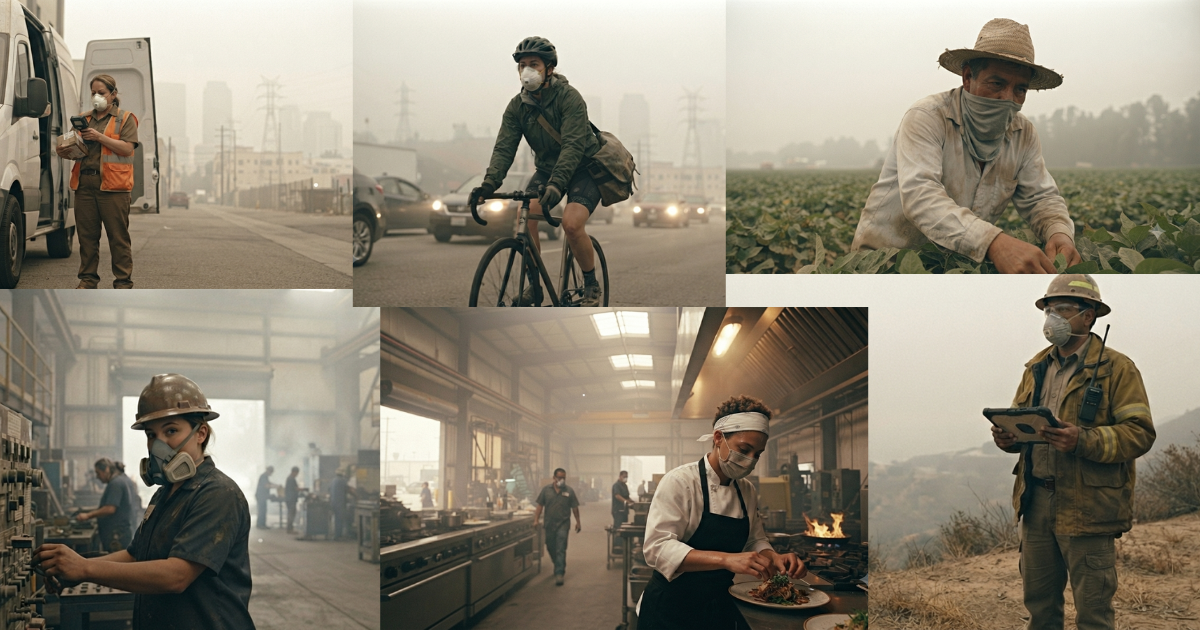
What should Employers do? The primary approach to minimize risks by reducing contact with the smoke as much as possible. Indoor, outdoor and outreaching Workers could be at risk.
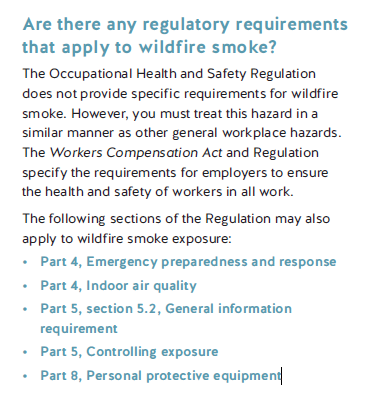
- Follow the Province of BC's air quality advisories.
- Read more about when Employers are required to provide respirators.
- Ensure you have appropriate policies and procedures and educate your Workers
- Reduce Workers' levels of physical activity outside - reschedule work
- Inspect, check then use HVAC systems. Reduce indoor particulate levels in small areas by using individual portable air cleaners
- Report and investigate serious incidents Read the full scoop at WorkSafe BC's FAQs.
What should Workers know? Speak with your Employer and safety committee about safety policies, reporting and support plans.
- Follow your worksite's policies and procedures.
- What are signs and symptoms of exposure? Who are your first aid attendants?
- If you work in a vehicle, WorkSafe BC advises that you keep your vents and windows closed and operate the air conditioning in recirculate mode
- Let your Employer know if you need accommodations. Read the full scoop at WorkSafe BC's FAQs.
Where to go for more information:
Province of BC's Air Quality Health Index (and they have an interactive map)
Methods for Measuring Heat Strain or Stress
Heat Stress Warning Poster (downloadable)